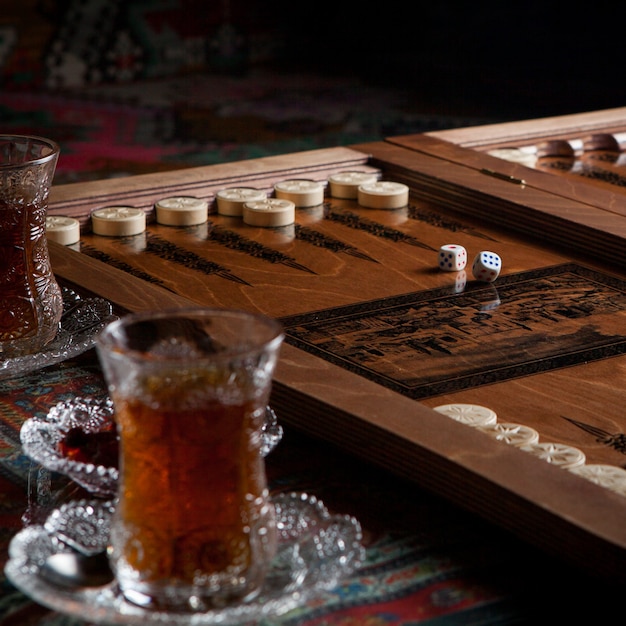
As chief manufacturing officer for Lahlouh, Inc., in Burlingame, California, Mike Lahlouh oversees the direct manufacturing activities of a company that provides marketing communications services for businesses in various industries. Outside of work, Mike Lahlouh enjoys traveling, following sports, and playing backgammon.
While the exact origins of the game are not exactly known, archeological evidence unearthed in recent years shows that backgammon has a long history dating back at least 5,000 years. It is widely believed that one of the earliest variants of the game was played in southern Mesopotamia, in what is now Iraq. Archeological evidence supporting this theory includes dice and 5,000-year-old gaming boards resembling the modern backgammon boards.
Outside of Mesopotamia, other early cultures also played variants of backgammon. These include cultures in China, Greece, Rome, and Egypt. Backgammon’s popularity among upper-class aristocracy and royalty in some parts of the world is thought to have earned it the monikers “The King of Games” and “The Game of Kings.”
From its earliest variants, backgammon spread in popularity to continental Europe and Great Britain. Board game historian H.J.R. Murray says that the modern game of backgammon is derived from an English game called “tables,” and, according to the Oxford Universal Dictionary, the first use of the word “backgammon” appeared in the mid-17th century. Later, in the mid-18th century, Edmond Hoyle published a treatise on backgammon that contained information about the rules and playing strategies for the game.
While interest in backgammon waned a bit in the 19th century, the popularity of the game increased after the invention of the doubling cube in the 1920s. That popularity continued throughout the 20th century as the game caught on in membership clubs throughout the United States. Today, backgammon is still a popular game that brings people together through in-person play and online computer programs.
 Mike Lahlouh